

Decoding and Engineering Cellular States in Human Disease
How do molecular programs within individual cells give rise to the complex behaviors of human tissues—and how can we intervene when these programs go awry?
The Yang Lab combines single-cell and spatial multi-omics, functional genomics, quantitative modeling, and machine learning to investigate cellular states and interactions in human disease. We are particularly interested in moving beyond descriptive molecular atlases to uncover the regulatory mechanisms, spatial organization, and dynamic interactions that shape disease progression and therapeutic response.
Our research spans cancer immunology and neurodegenerative disease, with three interconnected directions: decoding and engineering immune cell states, understanding spatial tissue ecosystems, and developing computational frameworks for high-resolution and dynamic tissue biology.

1. Decoding and Engineering Immune Cell States
Immune cells continuously adapt their molecular programs in response to signals from their tissue environment. We seek to understand the regulatory circuits that establish these states, determine their functional consequences, and ultimately learn how to manipulate them.
A major focus of our lab is dendritic-cell biology in cancer immunity. Using human tumor multi-omics, functional perturbations, and experimental models, we investigate immune states associated with response or resistance to cancer immunotherapy and identify the transcription factors, regulatory elements, and signaling pathways that control them. We are extending these discoveries toward functional perturbation and synthetic regulatory circuits designed to reprogram therapeutically important immune-cell states.
Selected Publications
- Yang J, et al. Mature and migratory dendritic cells promote immune infiltration and response to anti-PD-1 checkpoint blockade in metastatic melanoma. Nature Communications, 2025.
- Asnani M, and Yang J. Optimized Ex Vivo Differentiation of CD103+ Dendritic Cells and High-Efficiency Retroviral Transduction of Mouse Bone Marrow HSCs. BioRxiv, 2025
2. Mapping Spatial Tissue Ecosystems
Cells do not function in isolation. Their behavior depends on where they reside, which cells surround them, and the molecular signals exchanged within local tissue niches.
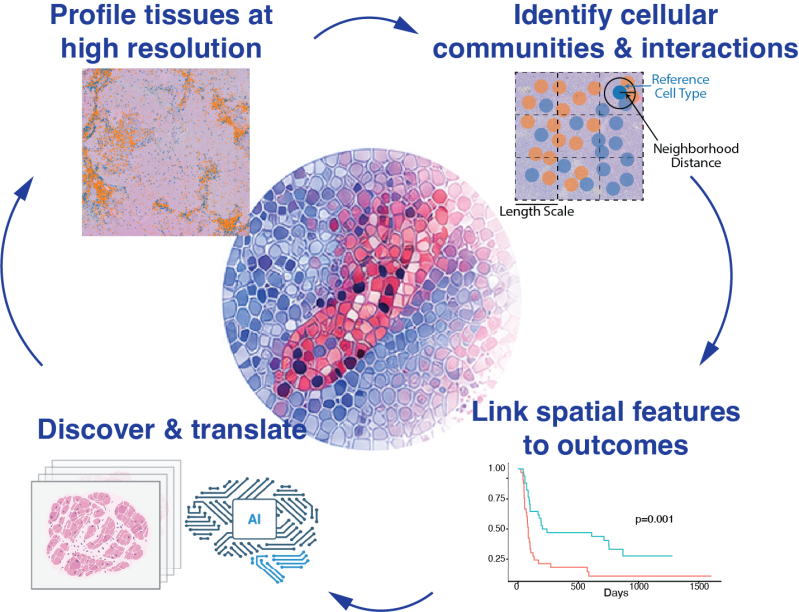
We use single-cell and spatial transcriptomics, epigenomics, imaging, and multimodal profiling to reconstruct these tissue ecosystems at cellular resolution. In cancer, we study how immune, endothelial, and tumor cells organize into spatial niches associated with therapeutic response and disease progression. In neurodegenerative disease, we investigate how cell-type-specific regulatory programs and tissue organization are altered across brain regions and disease states. These studies aim to identify spatial cellular interactions that cannot be understood from dissociated cells alone.
Selected Publications
- Sun C, et al. Epigenetically constrained astrocyte states underlie prefrontal cortex vulnerability in Down syndrome associated Alzheimer disease. BioRxiv, 2026
- Yang J, et al. Mature and migratory dendritic cells promote immune infiltration and response to anti-PD-1 checkpoint blockade in metastatic melanoma. Nature Communications, 2025.
3. Building Quantitative Models of Tissue Biology
Modern spatial and single-cell technologies provide increasingly detailed snapshots of human tissues, but transforming these measurements into mechanistic understanding requires new computational frameworks.
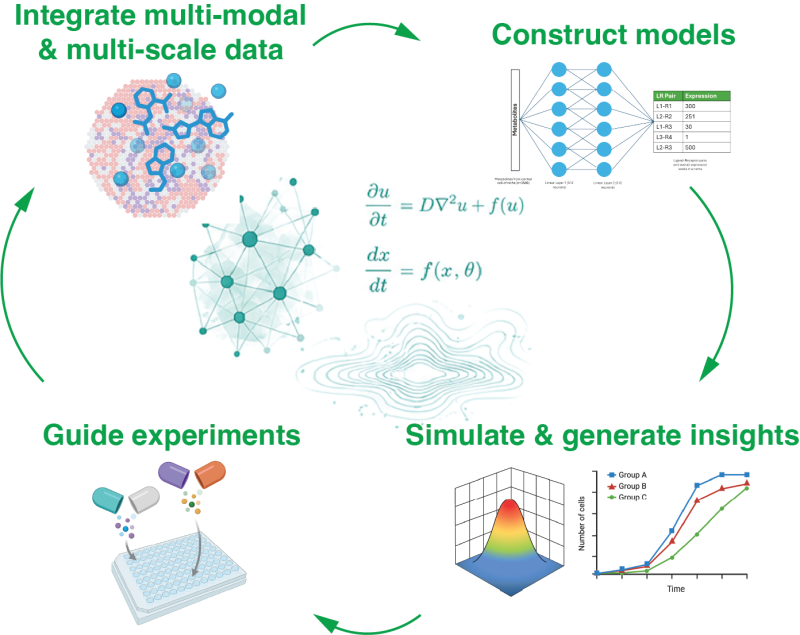
We develop statistical, machine-learning, and mathematical approaches to extract cellular organization and dynamics from high-dimensional multimodal data. Our work includes methods for reconstructing cells from sequencing-based spatial measurements, integrating complementary spatial technologies, modeling cell-state transitions and interactions, and connecting molecular observations to tissue-scale behavior.
A long-term goal is to move from static molecular snapshots toward predictive models of tissue dynamics—models that can generate testable hypotheses about how cellular states arise, interact, and respond to perturbation.
Selected Publications
- Wu L C, et al. STCS: A Platform-Agnostic Framework for Cell-Level Reconstruction in Sequencing-Based Spatial Transcriptomics. BioRxiv, 2026
- Qiu M, et al. GRNFormer: A biologically-guided framework for integrating gene regulatory networks into RNA foundation models. Association for Computational Linguistics, 2025.